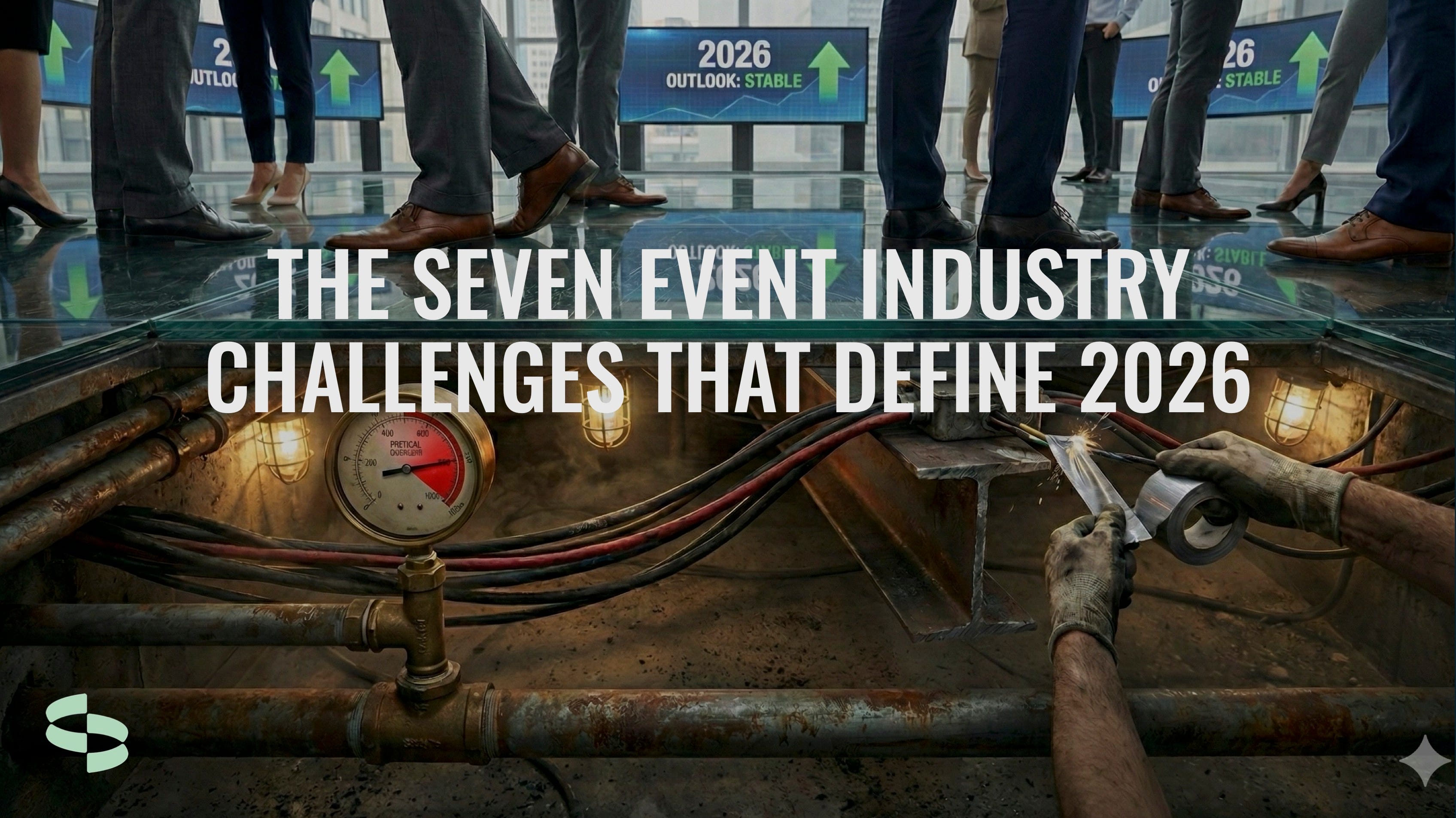
7 Event Industry Challenges that define 2026
Why 2026 Will Feel Harder for Events - Even As Business Stays Good(ish)
Most outlooks for 2026 are oddly reassuring. “Despite all challenges”, growth will continue, technology will advance, and travel will stabilise. Taken individually, they are plausible but generic. Taken together, they overlook many aspects that matter for the global events industry.
I realised this while reviewing my work from a year ago. Back then, I consolidated a broad set of “well-reputed” industry outlooks into a single “meta-outlook.” The result held up, but only just.
So – time for a different approach! I am a firm believer that the best insights can be found where views and perspectives intersect, where you look at issues from vastly different angles.
At jwc, as part of the work for our upcoming “Global Industry Performance Review” (GIPR), I spent a lot of time on the global trends section in recent days. As part of the research for this, I wanted to create a baseline 2026 outlook that combines three relevant perspectives:
· The Economist, whose World Ahead issue frames the year through geopolitics, demographics, and institutional strain.
· Scott Galloway’s annual predictions, focused on markets, capital, and technology colliding with economic limits.
· Skift Meetings Megatrends 2026, which is grounded not in theory, but in how events are actually being planned, staffed, and paid for.
I picked them because they ask different questions, and yet they arrive at the same key issues as far as our industry is concerned. The crossover gives good initial insights, and the seven points below gave as a useful input for the work on the “Global Trends” section in the GIPR Report.
1. AI: From Hype to Infrastructure
AI is no longer a novelty. It is becoming a utility. The Economist treats it as infrastructure, powerful but uneven, and constrained by energy and trust. Galloway is blunter, arguing that basic economics will soon deflate today’s exuberance. Another takeaway, familiar to our industry, is picked up by Skift: In a world saturated with synthetic content, live events gain value because they cannot be faked. Physical presence has become a form of verification.
2. The Fragmentation of Scale
Globalisation isn’t ending, but it is fragmenting. Markets now reward focus over reach. On the ground, I see planners moving away from the idea that “bigger” is automatically “better” - a strategic response to how people now spend their limited political and personal capital.
3. The Affordability Constraint
Cost is the constant pressure above and beneath the surface. Energy systems are tight, infrastructure is strained, and capital is cautious. For event planners, affordability is the defining constraint of 2026. Programs are shorter, destinations are closer, and production is leaner. Demand remains, but fewer organisations are willing to underwrite it without hard trade-offs.
4. The Institutional Pivot
Institutions, often dismissed as obsolete, are emerging as central players. The Economist argues they survive only by adapting; Galloway questions old monopolies, but not the necessity of coordination. We see this in the shift of convention bureaus, Skift argues: the successful ones have stopped “selling” and started acting as operating partners that absorb complexity for the organizer.
5. The Talent Leak
The weakest link is the industry’s engine room seem to be people. Demographics are working against us, and AI cannot replace experience. Skift identifies a widening knowledge gap as seasoned professionals exit and institutional memory leaks away. This risk is easy to overlook because it doesn’t show up in attendance figures, until the execution fails.
6. The Compression of Time
Time pressure is sharpening everything. Markets now punish long-dated assumptions, and political volatility has shortened approval cycles. Planning windows are getting tighter and tighter, even for large, well-funded programs. In 2026, speed and flexibility matter more than a high-gloss finish.
7. Politics as a Lead Indicator
Politics is no longer background noise. Visas, funding, security, and reputation now dictate where events go and who attends. What The Economist describes as systemic polarisation shows up in Skift’s reporting as real attendance losses. Organisers are now forced to calculate political risk as a line item.
The Big Picture? Parallel challenges, less margin for error
Three perspectives, and new insights, so let’s zoom out again to look at the “big picture” for the year.
What I see is a story about yet another set of parallel challenges. The events business is unlikely to slow down in 2026. But the margin for error changes. Assumptions that once held, such as those related to travel, staffing, budgets, lead times, and political neutrality, to name a few, now break faster and with less warning.
This is where all of the outlooks converge. For The Economist, friction is no longer episodic but structural. Galloway shows that markets respond by demanding proof and punishing excess. Skift predicts how that pressure manifests itself within the industry, where planners absorb it through tighter budgets, shorter timelines, and smaller team sizes.
This suggests that, in 2026, events designed to operate under pressure should succeed well, and leaders who are aware of the compromises they are willing to make in advance should be better equipped to handle the pressure.
Let’s check in again in a year.